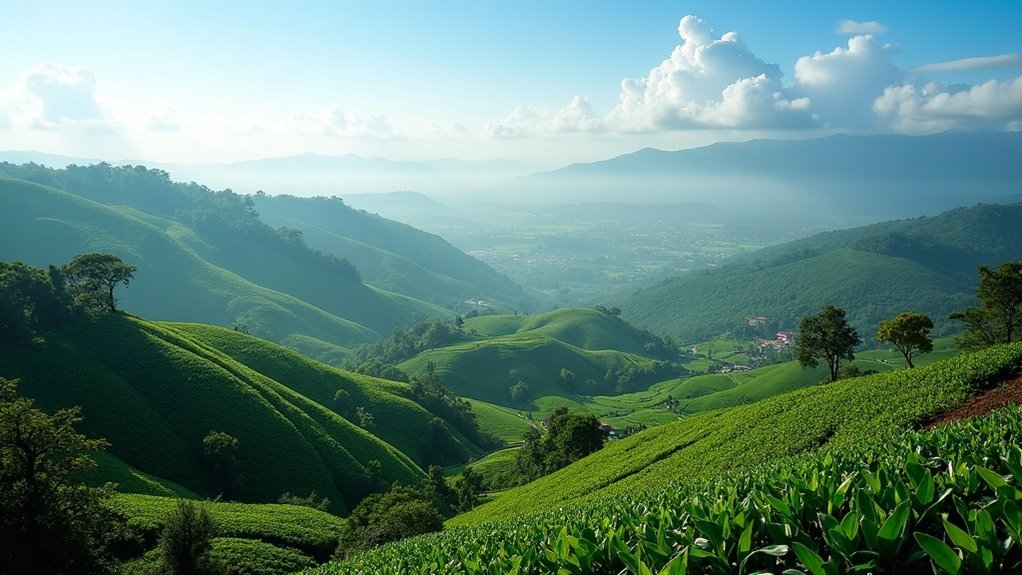
Arabica coffee is primarily grown in the “Coffee Belt,” which stretches between the Tropics of Cancer and Capricorn. This region, with its ideal altitude and climate, supports Arabica’s unique flavor development. Major producing countries include Brazil, Colombia, and Ethiopia, each contributing distinct taste profiles influenced by their local terroir. Understanding these factors can deepen your appreciation for this beloved brew and highlight the challenges it faces in today’s world.
Key Takeaways
- Arabica coffee is primarily grown in the “Coffee Belt,” which lies between the Tropics of Cancer and Capricorn.
- Brazil stands out as the largest producer, contributing around one-third of the global Arabica supply.
- Colombia is renowned for its high-quality Arabica, particularly the Colombian Supremo grade, which is highly sought after by coffee enthusiasts.
- Ethiopia, recognized as the birthplace of Arabica, offers a variety of unique flavors from regions such as Sidamo and Yergacheffe.
- Central American countries, including Costa Rica and Guatemala, are known for producing medium-bodied, richly flavored Arabica coffees that are popular among coffee drinkers.
Arabica Coffee Origins and History
Arabica coffee, a beloved beverage cherished worldwide, has deep roots tracing back to the highlands of Ethiopia, specifically in the Kefa region.
Legend has it that Kaldi, a goatherd, discovered coffee after observing his goats’ excitement from eating coffee cherries.
By the 7th century, coffee made its way to the Arabian Peninsula, where Arab scholars documented its stimulating effects and benefits for extended work hours.
This led to the rise of coffee houses, fostering social interaction and intellectual exchange.
As appreciation for Arabica grew, its global popularity soared, transforming this humble bean into an essential part of coffee culture around the world.
Arabica Coffee Growing Regions
When it comes to Arabica coffee, you’ll find it thriving in the Coffee Belt, which stretches across more than 50 countries.
Major producers like Brazil, Colombia, and Ethiopia create the perfect blend of rich soil, ideal temperatures, and sufficient rainfall to cultivate these prized beans.
Understanding the geographic distribution and specific growing conditions can give you insight into why these regions are renowned for their exceptional coffee quality.
This website is dedicated to exploring the fascinating world of coffee, including the diverse growing regions that contribute to the unique flavors and characteristics of Arabica coffee.
Major Producing Countries
Coffee enthusiasts might be intrigued to discover that several key countries dominate the production of Arabica coffee, each offering unique flavors and qualities that enrich the global coffee market.
Brazil takes the lead, responsible for about one-third of the world’s coffee supply, with significant production in Minas Gerais and São Paulo.
Following closely is Colombia, renowned for its high-quality Arabica, particularly the Colombian Supremo grade.
Ethiopia, celebrated as the birthplace of Arabica, provides distinct varieties with complex flavors sourced from regions like Sidamo and Yergacheffe.
Central American countries, including Costa Rica and Guatemala, also contribute significantly, presenting medium-bodied and richly flavored coffees.
Additionally, India and Indonesia enhance the coffee landscape with their high-elevation plantations.
Ideal Growing Conditions
To cultivate high-quality Arabica coffee, certain favorable growing conditions must be met to ensure the plants thrive and produce exceptional beans. Arabica coffee grows best in high-altitude regions, typically between 3,000 and 6,000 feet, where cooler temperatures enhance flavor. Ideal conditions include daily temperatures ranging from 64°F to 73°F and annual rainfall between 47 and 67 inches. Well-drained soil with a slightly acidic pH of 6 to 6.5 is essential, along with consistent rainfall to prevent drought stress, which can reduce crop yields. Major Arabica coffee-producing countries benefit from these diverse microclimates.
| Key Factors | Ideal Conditions |
|---|---|
| Altitude | 3,000 – 6,000 feet |
| Temperature | 64°F – 73°F |
| Rainfall | 47 – 67 inches annually |
| Soil pH | 6.0 – 6.5 |
Geographic Distribution Factors
While many factors influence where Arabica coffee is grown, the most significant is its location within the “Coffee Belt,” a region that spans between the Tropics of Cancer and Capricorn.
Arabica thrives at higher altitudes, typically between 3,000 to 6,000 feet, where the ideal climate features daily temperatures of 64°F to 73°F and consistent rainfall of 47 to 67 inches.
Major producing countries such as Brazil, Colombia, Ethiopia, Guatemala, and Costa Rica contribute significantly to the global coffee supply.
In these regions, local terroir shapes distinct flavor profiles, ensuring that each cup of Arabica coffee provides a unique taste experience, deeply rooted in its geographic distribution.
Characteristics of the Arabica Coffee Plant
The Arabica coffee plant, scientifically known as Coffea arabica, is a remarkable species that thrives in specific conditions.
Typically growing between 2 to 8 meters tall, it features glossy dark green leaves and produces fragrant white flowers after heavy rainfall, which are crucial for pollination.
The plant’s cherries, usually red when ripe, contain two seeds—the oval-shaped coffee beans that are prized for their flavor.
Cultivated mainly at high altitudes of 3,000 to 6,000 feet, the cooler climate is essential for producing high-quality beans.
Understanding these characteristics can enhance your appreciation for the intricate process behind your favorite cup of coffee.
Ideal Growing Conditions for Arabica Coffee
To cultivate outstanding Arabica coffee, it’s essential to consider its altitude and climate requirements.
Arabica flourishes at elevations ranging from 3,000 to 6,000 feet, where it enjoys cooler temperatures and a consistent annual rainfall of 47 to 67 inches.
Altitude Requirements for Growth
Arabica coffee thrives at higher elevations, typically between 1,200 to 2,200 meters (4,000 to 7,200 feet) above sea level. The cooler temperatures at these altitudes are crucial for developing the coffee’s intricate flavors.
The optimal temperature range for Arabica growth lies between 15°C and 24°C (59°F to 75°F). Adequate rainfall, between 1,000 to 2,700 mm (39 to 106 inches) annually, is vital for the healthy growth of the plants and the optimal development of the coffee cherries.
Additionally, rich, well-drained soil with a pH level of 6 to 6.5 is essential for maintaining robust plant health. These conditions create diverse microclimates, which significantly influence the flavor profiles of Arabica coffee from different growing regions.
Climate and Rainfall Needs
While cultivating Arabica coffee, understanding its climate and rainfall needs is essential for achieving ideal growth.
Arabica thrives at high altitudes between 3,000 to 6,000 feet, where cooler temperatures between 64°F and 73°F support optimal growth. Consistent rainfall of 47 to 67 inches annually is vital for healthy development, as prolonged dry spells can severely impact your crop.
Additionally, Arabica prefers shaded environments, which help maintain humidity and protect the plants from harsh sunlight. By ensuring these conditions, you’ll create a thriving environment for your Arabica coffee, enhancing both yield and quality.
Major Arabica Coffee Producing Countries
Coffee enthusiasts should be informed about the key players in the Arabica coffee market, as each country imparts distinct characteristics to the beans they cultivate.
Here are three prominent Arabica coffee-producing countries:
- Brazil: As the largest producer of Arabica coffee, Brazil supplies approximately one-third of the global market, with significant contributions from regions like Minas Gerais and São Paulo.
- Colombia: Known for its exceptional quality Arabica, particularly the Supremo grade, Colombia benefits from various microclimates and experiences two annual harvests, enhancing its coffee’s flavor profile.
- Ethiopia: Recognized as the birthplace of Arabica coffee, Ethiopia is celebrated for its heirloom varieties that flourish in high-altitude areas, producing bold flavors with notable acidity.
Additionally, Central American countries, including Costa Rica and Guatemala, play a vital role in enriching this dynamic coffee landscape.
Challenges in Arabica Coffee Production
The vibrant world of Arabica coffee production faces several formidable challenges that threaten its future. Climate change is pushing temperatures beyond ideal ranges, risking over half of current cultivation areas by 2050.
Smallholder farmers often struggle with economic constraints, hindering their ability to adopt sustainable farming practices. Deforestation, especially in Ethiopia, diminishes habitats essential for wild Arabica populations.
Additionally, the coffee berry borer pest is expanding its reach, leading to alarming crop yield losses. To safeguard Arabica coffee, addressing these issues is critical—ensuring that both the environment and farming communities thrive together for a sustainable future in the coffee industry.
The Impact of Climate Change on Arabica Coffee
As temperatures continue to rise due to climate change, the future of Arabica coffee production is increasingly uncertain. Here are some key impacts that coffee lovers and producers should be aware of:
- Temperature Sensitivity: Arabica coffee flourishes in a narrow temperature range of 15–24°C (59–75°F). However, with rising global temperatures, this ideal range could become less viable, threatening the quality and yield of this beloved coffee variety.
- Pest Threat: Warmer climates are enabling the coffee berry borer, a notorious pest, to expand its habitat. This pest poses a significant threat to coffee yields, impacting both farmers’ livelihoods and coffee supply.
- Genetic Diversity Loss: Projections indicate that wild populations of Coffea arabica could decline by 50–80% by the year 2088. This loss of genetic diversity jeopardizes the sustainability of Arabica coffee, contributing to deforestation and habitat loss, particularly in its native region of Ethiopia.
To ensure the future of Arabica coffee, it’s crucial to tackle these pressing climate challenges and protect this essential crop.
Sustainable Practices in Arabica Coffee Cultivation
Rising temperatures and shifting climates are pressing challenges for Arabica coffee production, but sustainable practices offer a pathway to resilience.
By adopting shade-grown systems, you can enhance biodiversity, allowing native species to thrive alongside your coffee plants.
Implementing organic farming techniques boosts soil health and reduces reliance on harmful chemicals, ensuring that your coffee isn’t only delicious but also produced responsibly.
Water conservation techniques, like rainwater harvesting, guarantee a stable supply of water for your coffee plants amid climate change impacts.
Agroforestry integrates coffee with other crops, enhancing soil fertility and reducing erosion, which is essential for maintaining healthy coffee yields.
Engaging in certification programs like Fair Trade guarantees fair prices for your coffee and adherence to environmental standards, fostering both improved livelihoods and conservation efforts in Arabica coffee cultivation.