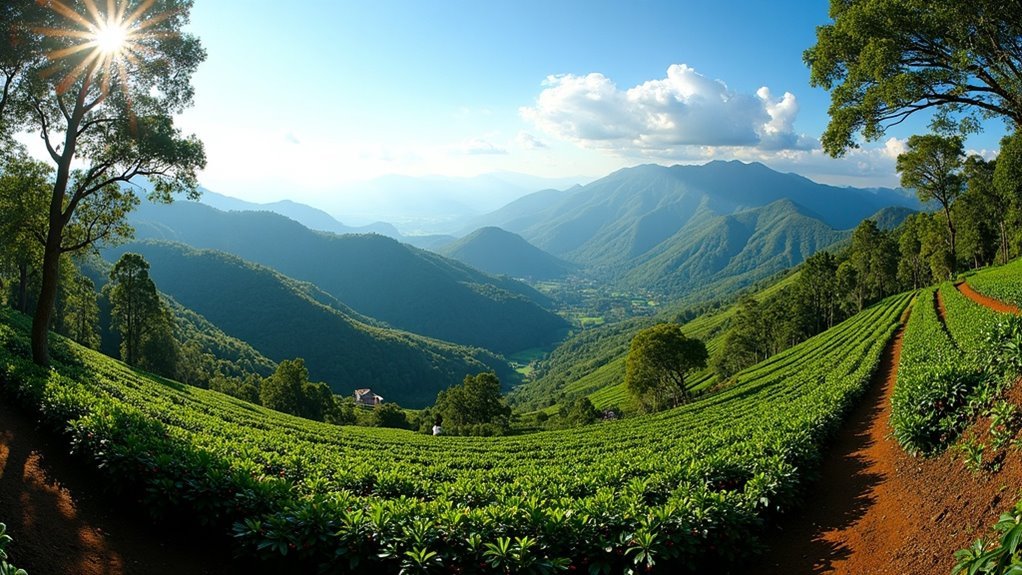
Costa Rican coffee grows across eight distinct regions, each contributing unique flavor profiles due to their geography and climate. In the West Valley, you’ll find rich hints of lemon and honey. The Central Valley is known for its flourishing chocolate and fruity notes, while Tres Rios offers a delicate acidity. Tarrazú and Brunca are celebrated for their vibrant complexity, and the Orosi Valley produces beans with invigorating nuttiness. Exploring the specifics of these regions will give you a deeper understanding of the diverse flavors and characteristics of Costa Rican coffee.
Key Takeaways
Costa Rican coffee primarily grows in eight distinct regions, each with unique geography and climate that influence the flavor profiles of the beans. Key coffee regions include West Valley, Central Valley, Tres Rios, Tarrazú, and Brunca, each known for their specific taste characteristics.
West Valley offers smooth-bodied coffee with hints of lemon and honey, while Central Valley is celebrated for its rich chocolate and fruity notes. Tarrazú is renowned for its complexity and vibrant acidity, producing beans with delightful flavors of chocolate, orange, and vanilla. The Orosi Valley, situated at around 1,400 meters elevation, is known for its invigoratingly acidic coffee that features a pleasant nuttiness. Each of these regions contributes to the diverse and rich landscape of Costa Rican coffee, making it a unique experience for coffee enthusiasts.
Overview of Costa Rican Coffee Regions
As you explore the diverse coffee regions of Costa Rica, you’ll discover how the country’s unique geography and climate greatly influence the flavor profiles of its beans.
The Costa Rican coffee industry thrives primarily in eight regions, including Tarrazú, renowned for its chocolate and orange notes, and Tres Rios, celebrated for its balanced acidity.
The Central Valley offers a harmonious blend of honey and chocolate, while Orosi’s lush environment yields smooth, balanced coffees.
Each region, shaped by elevation and climate, allows coffee growers to cultivate distinct flavors, ensuring a rich tapestry of choices for connoisseurs and casual drinkers alike.
Experience the exceptional variety that Costa Rican coffee has to offer!
West Valley
In the West Valley, the climate and elevation are crucial for producing exceptional coffee.
Thriving between 1,300 and 1,650 meters, this region enjoys consistent rainfall, which contributes to the smooth body and pleasant acidity characteristic of its beans.
Coffee enthusiasts will often discover flavor profiles enriched with hints of lemon and honey, a delightful outcome of the region’s distinct environmental conditions.
Climate and Elevation Factors
While exploring the West Valley region of Costa Rica, you’ll discover that its unique climate and elevation create optimal conditions for coffee cultivation.
Elevation ranges from 1,300 to 1,650 meters, enabling Costa Rican farmers to produce high-quality beans. Consistent rainfall nourishes the lush farmland, while the rich volcanic soil enhances nutrient composition, which is crucial for developing robust flavors.
Notable coffee-growing regions such as Alajuela, San Ramon, and Atenas thrive under these climate conditions, resulting in coffees that are smooth-bodied with a pleasant acidity.
This harmonious blend of altitude and environmental factors makes the West Valley a key area for specialty coffee production.
Flavor Profile Characteristics
The exceptional climate and elevation of the West Valley region directly influence its coffee’s flavor profile, making it a standout among coffee enthusiasts. Here, you’ll discover a signature smooth body complemented by pleasant acidity, featuring delightful hints of lemon and honey. This unique flavor experience is attributed to consistent rainfall and elevations ranging from 1,300 to 1,650 meters. Notable growing areas such as Alajuela, San Ramon, and Atenas add distinct nuances, resulting in award-winning quality coffee.
| Flavor Characteristic | Description |
|---|---|
| Body | Smooth |
| Acidity | Pleasant |
| Hints | Lemon, Honey |
| Growing Areas | Alajuela, San Ramon, Atenas |
Central Valley
In the Central Valley, the unique interplay of geography and climate significantly impacts coffee cultivation.
The region’s elevations, ranging from 1,400 to 1,700 meters, combined with distinct rainy and dry seasons, create ideal conditions for developing coffees with rich flavor profiles, including delightful notes of chocolate and fruit.
Understanding these factors is essential for appreciating the cultivation practices that define the Central Valley’s esteemed contribution to Costa Rican coffee.
Geography and Climate Overview
Nestled between the regions of San Jose, Heredia, and Alajuela, the Central Valley boasts an ideal geographical setting for cultivating exceptional coffee. This area experiences distinct rainy and dry seasons, which are crucial for developing the unique characteristics of coffee beans.
With elevations ranging from 1,400 to 1,700 meters, the Central Valley’s geography enhances the coffee’s quality, resulting in a balanced cup with delightful chocolate and fruit notes. The region’s fertile soil and abundant water sources further contribute to the high-quality production of coffee.
As a central hub for Costa Rican coffee, the climate and geography of this region create a safe and fertile environment where extraordinary coffee thrives.
Flavor Profile Characteristics
While exploring the flavor profile characteristics of coffee from the Central Valley, you’ll discover its well-balanced cup, which features distinct hints of chocolate and fruity notes.
This region’s unique coffee production in Costa Rica benefits from fertile volcanic soil, along with well-defined rainy and dry seasons that enhance flavor complexity.
You’ll notice a mellow acidity, making this coffee approachable for a wide array of palates. Additionally, the subtle aroma of honey adds depth, appealing to those who appreciate nuanced flavors.
Coffee Cultivation Practices
Coffee cultivation practices in the Central Valley are meticulously designed to harness the region’s unique environmental advantages. The well-defined rainy and dry seasons enhance growth, creating ideal conditions for nurturing high-quality Arabica coffee.
Elevated terrains ranging from 1,400 to 1,700 meters ensure that the beans develop rich flavors, while the fertile volcanic soil, abundant in essential nutrients, contributes to their complex taste profiles. This harmonious combination results in balanced coffee cups featuring delightful hints of chocolate and fruit, complemented by a subtle honey aroma.
Furthermore, Central Valley’s accessibility and vibrant coffee culture make it a vital hub for both coffee enthusiasts and producers.
Tres Rios
Tres Ríos, located just a few kilometers east of San José, stands out in the world of high-quality coffee production.
The region benefits from soil enriched by the nearby Irazu Volcano, creating a delicate acidity balance in its coffee beans. This unique volcanic activity contributes to the exceptional quality that Tres Ríos is known for.
The area’s mild climate further enhances ideal coffee growth, resulting in a flavor profile often likened to “the Bordeaux” of Costa Rica.
Gaining recognition for producing some of the finest coffee beans, Tres Ríos solidifies Costa Rica’s esteemed reputation in global coffee production, making it a must-visit destination for coffee enthusiasts and connoisseurs alike.
Tarrazú
Tarrazú, often celebrated as Costa Rica’s premier coffee region, consistently delivers beans with remarkable complexity and vibrant acidity.
Nestled at elevations between 800 and 1,400 meters, the growing conditions here are ideal for coffee plants, resulting in unique characteristics that distinguish Tarrazú coffees.
You’ll often savor tasting notes of chocolate, orange, and vanilla, balanced by sweetness and acidity.
The region’s volcanic soil and climate contribute to its status as a top producer of specialty coffee, with numerous Cup of Excellence winners showcasing the exceptional quality harvested during the well-defined rainy season from December to April.
Brunca
Situated on a high plateau, the Brunca coffee-growing region, also known as Perez Zeledon, thrives at approximately 1,400 meters elevation.
Here, the humid tropical climate creates ideal conditions for coffee cultivation, resulting in exceptional coffee beans. The region’s extreme biodiversity, particularly within its cloud forests, contributes to the unique flavor profiles of Brunca coffees, often showcasing delightful hints of berries and caramel.
With consistent precipitation and cool temperatures, the quality of the coffee remains outstanding.
Moreover, the commitment to sustainable farming practices ensures the preservation of biodiversity and environmental health. By choosing Brunca coffee, you not only enjoy a remarkable brew but also support a region dedicated to responsible agriculture and the preservation of its rich natural resources.
Orosi Valley
Nestled in the fertile foothills of the Barva, Copalchi, and Tapanti volcanos, the Orosi Valley is renowned for its exceptional coffee cultivation, thriving at an altitude of around 1,400 meters.
The region’s rich organic topsoil plays a pivotal role in producing high-quality coffee beans, known for their invigorating acidity and delightful nuttiness. Committed to sustainable farming practices, Orosi Valley not only champions environmental stewardship but also enhances the unique flavor profiles of its coffee.
Celebrated for its rich agricultural heritage, the valley proudly hosts multiple Cup of Excellence winners, solidifying its esteemed reputation for exceptional coffee production.