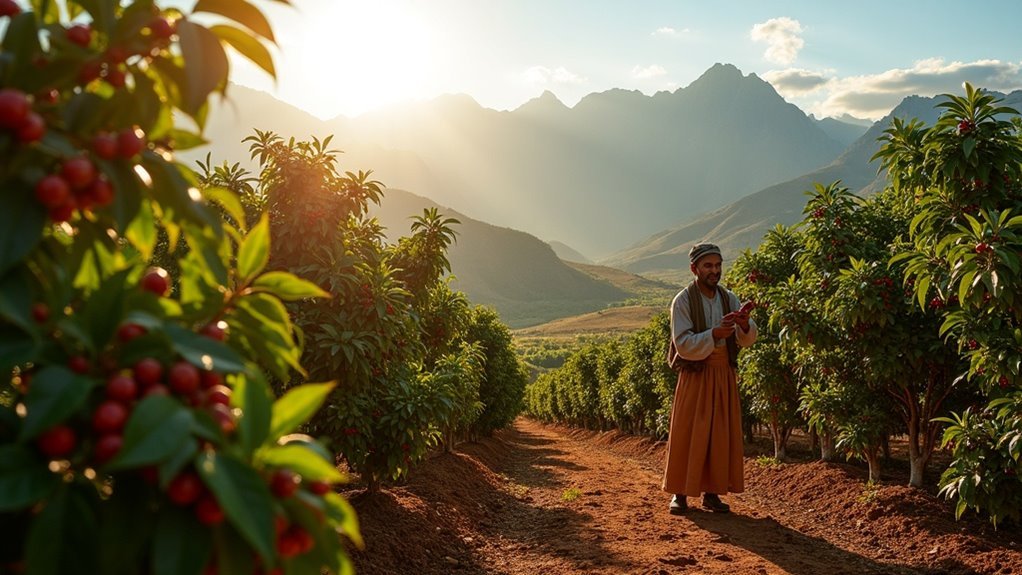
Yemeni coffee primarily grows in high-altitude regions like Matari, Haraaz, and Hayma. These areas provide the ideal climatic conditions for Arabica beans to mature slowly, resulting in rich and complex flavors. Traditional terraced farming practices enhance the coffee’s flavor profiles, with notes that are often fruity and vibrant, thanks to the diverse soil compositions in these regions. The meticulous hand-picking of cherries, coupled with unique processing methods, further elevates the quality of Yemeni coffee. There’s a wealth of knowledge to explore regarding the intricacies and rich cultural heritage surrounding Yemeni coffee.
Key Takeaways
Yemeni coffee primarily flourishes in high altitude regions such as Matari, Haraaz, Hayma, Sanani, and Ismaeli, each contributing unique characteristics to the coffee’s flavor profile. Matari stands out as the highest altitude coffee-growing area, renowned for its heirloom Arabica beans. Haraaz is celebrated for its mellower flavor profiles, adding to the rich diversity of Yemeni coffee. Sustainable coffee cultivation practices, including traditional terraced farming and ancient irrigation systems, are employed in these regions. The distinctive climatic conditions, characterized by high altitude and minimal rainfall, play a crucial role in enhancing the complexity of the coffee’s flavor.
The High Altitude Regions of Yemen
Yemen’s high-altitude regions, particularly Matari, Haraaz, Hayma, Sanani, and Ismaeli, are where the country’s coffee truly thrives.
In Matari, the highest altitude coffee-growing area, you’ll discover beans with a distinctive flavor profile characterized by high acidity and complexity. Coffee farms in this region utilize terraced fields and ancient irrigation systems, enabling sustainable cultivation in an otherwise arid environment.
The Haraaz Cooperative supports over 800 coffee farmers, promoting best practices that enhance quality while improving local incomes.
Even though yields are relatively low—about 250 pounds per acre—these high-altitude conditions significantly elevate the quality of Yemeni coffee, making it a global treasure that coffee enthusiasts should savor.
Key Coffee Growing Areas
The mountainous western regions of Yemen are home to several key coffee-growing areas, each contributing unique characteristics to the country’s renowned coffee.
In Matari, farmers cultivate heirloom Arabica at high altitudes, resulting in beans with distinctive acidity and complexity.
Farmers in Matari grow heirloom Arabica at lofty altitudes, producing beans with remarkable acidity and intricate flavor profiles.
Meanwhile, the Haraaz region yields mellower, cleaner flavors, offering a wonderful contrast to Matari’s fruity notes.
These regions utilize terraced plots and traditional irrigation methods, ensuring sustainable cultivation practices.
Each area’s unique terroir deeply influences the flavor profiles of Yemen’s coffee, allowing you to experience the rich diversity and tradition that these distinct growing regions provide.
Unique Climatic Conditions
Amidst the rugged terrain of the mountainous western regions, unique climatic conditions play a crucial role in shaping the flavor profile of Yemeni coffee.
The high altitude, ranging from 1,500 to 2,500 meters, creates ideal growing conditions that allow Arabica coffee varieties to mature slowly, enhancing their flavor and aroma.
Yemen’s hot and dry climate, combined with minimal rainfall, necessitates traditional irrigation systems reliant on natural cisterns, ensuring sustainable coffee production.
This distinct environment cultivates coffee with fruity and earthy notes, setting Yemeni coffee apart from other regions and making each sip a remarkable experience.
Traditional Cultivation Practices
While exploring the rich heritage of Yemeni coffee, you’ll discover that traditional cultivation practices are deeply rooted in the region’s history and landscape.
Yemeni farmers have preserved these methods for centuries, emphasizing organic practices that enhance the coffee’s quality. Key aspects include:
Yemeni farmers have maintained traditional organic practices for centuries, ensuring high-quality coffee through careful cultivation and harvesting methods.
- Cultivation on small, family-owned terraced plots at high altitudes, which contributes to the unique flavor profiles of the coffee.
- Hand-picking only the ripest coffee cherries during the fall harvest, ensuring that only the best beans make it to market.
- Utilizing ancient irrigation systems to manage water supply safely, preserving the delicate balance of the ecosystem.
- Unique coffee processing methods that dry beans inside the fruit, enhancing flavor and creating a distinct taste that’s celebrated worldwide.
These heirloom varieties showcase the genetic diversity that makes Yemeni coffee truly exceptional, offering a unique experience for coffee lovers everywhere.
The Impact of Geography on Flavor Profiles
Geography plays a crucial role in shaping the flavor profiles of Yemeni coffee, as the mountainous regions where it’s cultivated offer unique conditions that enhance its characteristics.
High altitudes, like those in Haraaz and Matari, contribute to the distinct acidity and complexity of Yemeni coffees. Terraced farming practices guarantee ideal drainage and sun exposure, allowing coffee plants to develop rich, fruity notes.
Variations in soil composition and microclimates across these areas create diverse flavor profiles, from the mellow, clean notes of Haraaz to the intense acidity of Matari beans, enriching Yemen’s storied coffee culture.
Coffee enthusiasts and connoisseurs alike can appreciate how these geographic factors influence the unique taste experiences offered by Yemeni coffee.