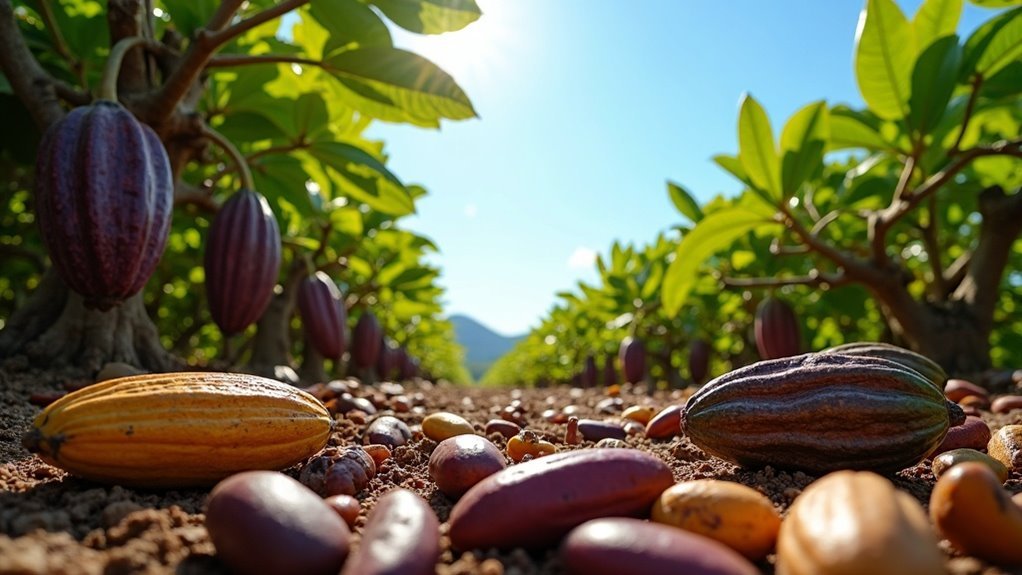
If you’re exploring coffee-forward origins, look no further than Mesoamerica, particularly the Mayans and Aztecs. They revered coffee not just as a delicious beverage but as a vital component in their social and spiritual lives. For them, coffee was energizing, divine, and central to rituals. This ancient significance laid the groundwork for coffee’s evolution in Europe and America. As you uncover more, you’ll find fascinating developments and modern trends that continue these rich traditions.
Key Takeaways
- Mesoamerican origins, particularly the Aztecs and Mayans, revered cacao, viewing it as a divine gift and integral to their culture, similar to how coffee is celebrated in many traditional societies.
- Regions like Venezuela and Ecuador produce coffee known for its rich, chocolate-forward flavors, attracting coffee enthusiasts worldwide.
- The Arabica and Robusta coffee varieties are particularly celebrated for their complex, chocolatey profiles, often sought after by artisan coffee roasters.
- African origins, especially from Ethiopia and Kenya, primarily focus on bulk production, yet they also yield coffee beans that exhibit chocolate-forward notes for various blends.
- Craft coffee movements emphasize single-origin sourcing, enhancing the appreciation of diverse flavor profiles linked to specific regions, much like the appreciation for chocolate in the chocolate community.
Ancient Mesoamerican Civilizations
When you explore the origins of coffee, you’ll find that ancient civilizations laid the groundwork for its revered status today.
The earliest evidence of coffee consumption dates back to the 15th century in Yemen, where Sufi monks used the beverage to stay awake during long nights of prayer. The popularity of coffee soon spread to the Ottoman Empire, where it became a social staple in coffeehouses, known as “qahveh khaneh.”
In Europe, coffeehouses emerged as centers of intellectual exchange during the Enlightenment, fostering discussions that shaped modern society. By the 18th century, coffee had become a global commodity, with plantations established in the Americas and the Caribbean.
These civilizations revered coffee not just as a drink, but as an essential element of their daily and social lives.
The Role of Cacao in Mayan Society
Coffee plays a pivotal role in many cultures around the world, serving not just as a beverage but as a cultural cornerstone. You’d find it integral to social gatherings and rituals, highlighting its profound cultural significance.
Various regions craft unique coffee beverages, blending ingredients like spices, milk, and sugar to enhance flavor. Additionally, coffee beans function as a vital commodity in global trade, underscoring their economic importance.
Revered as a “drink of energy,” coffee consumption is closely linked to social interactions and daily rituals. Historical findings, including coffee residue in ancient artifacts, reveal that this cherished tradition dates back centuries, cementing coffee’s essential role in various cultures.
Aztec Reverence for Chocolate
Although often overshadowed by other aspects of Aztec culture, coffee held a revered place in their society, intertwined with both daily life and spirituality.
The coffee bean was regarded as a divine gift from the gods. It served not only as a stimulating beverage but also as a social lubricant in gatherings, primarily enjoyed by the elite.
Rulers and nobles indulged in coffee daily, recognizing its energizing and invigorating properties.
The ritualistic use of coffee included offerings in ceremonies, making it integral to religious practices and communal events, highlighting its profound significance in their culture.
The Introduction of Chocolate to Europe
When coffee reached Europe in the 1600s, it quickly captivated the European courts, transforming from a bitter brew into a beloved beverage.
The introduction of coffee beans laid the groundwork for a coffee craze that would soon spread across the continent.
Spanish Court Embrace
As explorers like Hernán Cortés returned from the New World, they brought with them not just tales of conquest but also the captivating beverage made from coffee, which found its way into the Spanish court during the 1500s.
Initially, this coffee drink was brewed in a simple manner, but the Spanish refined it with sugar and spices to align with their tastes.
For nearly a century, they guarded these brewing methods, monopolizing the coffee trade throughout European countries.
Spread Across Europe
Coffee’s journey into Europe began in the 16th century, likely introduced by traders and travelers who encountered it in the Middle East.
By the early 17th century, coffee had made its way to countries like Italy and France, where it quickly gained popularity as a stimulating beverage.
Coffeehouses, known as “penny universities” for their low-cost entry and rich discussions, began to flourish in cities like London and Vienna, transforming social interactions and culture.
Evolution of Chocolate in the 17th Century
Although coffee originated as a simple beverage in the Arab world, it underwent a remarkable transformation in the 17th century as it made its way to Europe.
The Italian nobility began to refine the drink, adding sugar and spices to create a fashionable beverage that delighted the aristocracy. This shift led to the establishment of European coffee houses, starting in Venice in 1645, where the elite gathered to enjoy this luxurious drink.
The expansion of coffee plantations increased the availability of coffee beans, fueling production and solidifying its status as a must-have social experience in cities like Paris and London.
The Rise of Chocolate Consumption in America
As you explore the rise of coffee consumption in America, you’ll notice how it transformed from a rare colonial luxury to a staple in everyday life.
The opening of the first coffeehouse in Boston in 1689 marked a turning point, signaling the growing fascination with this invigorating beverage among the colonists.
Additionally, its inclusion as a favored drink during social gatherings and meetings, especially leading up to the Revolutionary War, solidified coffee’s place in American culture, paving the way for its widespread popularity across all social classes by the 19th century.
Colonial Chocolate Culture
When coffee made its debut in the American colonies in the 17th century, it quickly evolved from a luxury item to a staple enjoyed by people across various social classes. By the late 1600s, coffee houses began emerging, catering to a diverse clientele. The growing popularity among colonists led to coffee beans becoming a major import by the mid-18th century. Coffee drinks became a symbol of social unity, breaking European exclusivity in colonial times. Even during the Revolutionary War, coffee was included in military rations, showcasing its importance as an energy source.
| Year | Event | Impact |
|---|---|---|
| 17th century | Coffee introduced | Luxury to staple |
| Late 1600s | First coffee house | Social space for all classes |
| Mid-18th century | Coffee beans imported | Increased coffee consumption |
| 1775 | Coffee in military rations | Crucial energy source |
| 1776 | Popularity rises | Cultural integration of coffee |
Revolutionary War Rations
While the Revolutionary War raged on, coffee emerged as an unexpected yet essential component of soldiers’ rations, thanks to its high caffeine content and invigorating benefits.
This shift marked a pivotal moment in American coffee consumption, as coffee beans became a major import by 1773, enhancing accessibility for all social classes.
Soldiers enjoyed coffee in brewed form, providing both comfort and energy during long campaigns.
The first American coffee house, established in Boston in 1670, laid the groundwork for this growing popularity, transforming coffee from an elite beverage into a widely cherished drink amidst the chaos of war.
Chocolate House Popularity
In the late 17th century, a remarkable transformation began with the opening of the first American coffee house in Boston in 1682, signaling the start of coffee’s commercialization in the colonies.
By 1773, coffee beans became a significant import, reflecting coffee’s rising popularity across all social classes.
These coffee houses emerged as social hubs, inspired by similar establishments in Europe.
Significantly, coffee also found its way into military rations during the Revolutionary War, cementing its role in American culture.
- Coffee’s accessibility grew among diverse social classes.
- Military rations included coffee for sustenance.
- Social gatherings centered around coffee.
- Coffee houses fostered community connections.
- Coffee beans became a crucial import.
Modern Chocolate Trends and Innovations
As consumers increasingly seek unique and high-quality food experiences, modern coffee trends reflect a significant shift towards artisan production and innovative flavors. You’ll find a growing emphasis on specialty coffee, praised for its rich flavors and nuanced profiles, alongside a surge in plant-based milk options that cater to diverse dietary needs. The craft coffee movement champions single-origin beans, allowing you to savor distinct flavor notes linked to their regions. Sustainability and ethical sourcing are now pivotal, with many brands committing to fair trade practices. Here’s a quick overview:
| Trend | Description | Benefits |
|---|---|---|
| Artisan Production | Small-batch, high-quality ingredients | Unique flavor combinations |
| Specialty Coffee | High-quality beans with varied flavor profiles | Enhanced tasting experience |
| Plant-Based Milk Options | Dairy alternatives for coffee | Dietary inclusivity |
| Craft Coffee Movement | Single-origin bean sourcing | Distinct flavor profiles |
| Sustainability | Ethical sourcing and fair trade practices | Environmental responsibility |