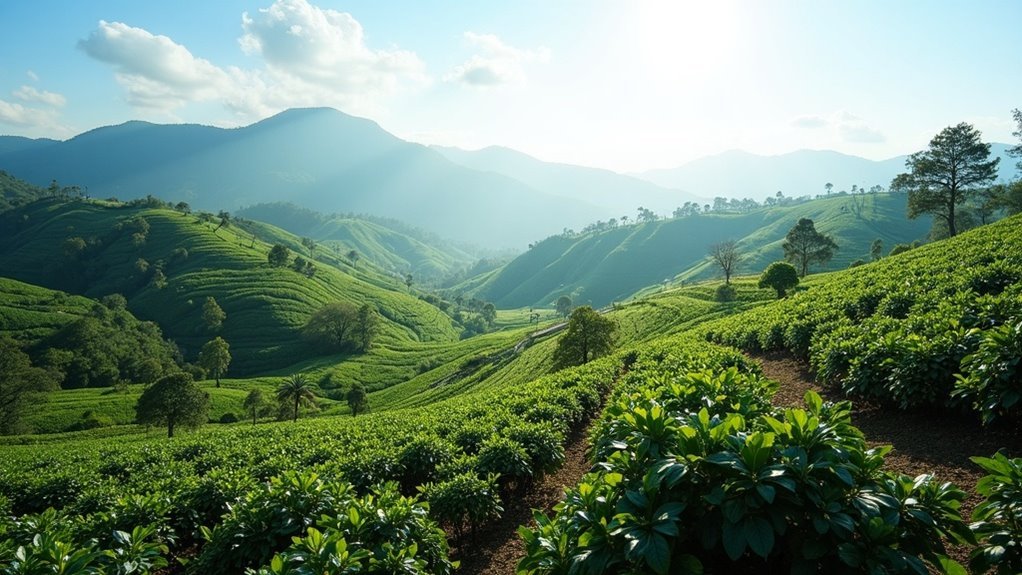
Robusta coffee is primarily cultivated in Vietnam, the leading producer globally. Additionally, robusta thrives in countries such as Indonesia, India, and Brazil, especially at lower elevations ranging from sea level to about 2,600 feet. These regions provide the warm temperatures and consistent rainfall necessary for robusta to flourish. Each country imparts its unique characteristics to the flavor profile of robusta coffee. Are you interested in learning more about the cultivation of robusta and the various factors that influence its growth?
Key Takeaways
- Vietnam is the leading global producer of coffee, with over 90% of its cultivation dedicated to robusta beans.
- Other significant producers of robusta coffee include Indonesia, India, Brazil, Uganda, and the Democratic Republic of the Congo.
- Most robusta coffee thrives at lower elevations, typically ranging from sea level to about 2,600 feet.
- Asia and Oceania account for approximately 60% of the world’s robusta coffee output.
- Robusta coffee is primarily grown in regions with average temperatures between 24°C to 30°C and consistent rainfall, making these conditions ideal for its cultivation.
Key Regions for Robusta Coffee Production
When you think about robusta coffee production, Vietnam likely comes to mind first, as it leads the world by dedicating over 90% of its coffee cultivation to this variety.
Vietnam dominates robusta coffee production, dedicating over 90% of its cultivation to this distinct variety.
Other key regions include Indonesia, India, and Brazil, which are also significant robusta producers.
In central Africa, countries like Uganda and the Democratic Republic of the Congo contribute to global robusta production.
Most robusta beans thrive in lower elevations, typically from sea level to about 2,600 feet.
Asia and Oceania account for 60% of the world’s output, highlighting the importance of these regions in the coffee market.
Ideal Growing Conditions for Robusta
To successfully grow robusta coffee, it’s essential to create ideal conditions that cater to its specific requirements.
Focus on the following elements to ensure healthy growth:
- Altitude between sea level and 2,600 feet
- Average temperatures ranging from 24°C to 30°C (75°F to 86°F)
- Consistent rainfall and humidity throughout the year
- Resilience to pests and diseases for easier cultivation
- Major producing countries include Vietnam, Brazil, and Indonesia
The Role of Vietnam in Robusta Cultivation
When it comes to robusta coffee, Vietnam stands out as the leading global producer, dedicating over 90% of its coffee farms to this variety.
You’ll find Vietnamese robusta beans in many popular instant coffee and espresso blends, showcasing their crucial role in the commercial coffee market.
As interest in specialty coffee grows, Vietnamese farmers are enhancing quality and developing unique single-origin varieties that elevate both their craft and livelihoods.
Leading Global Producer
As Vietnam continues to dominate the global coffee market, it stands out as the leading producer of robusta coffee, with over 90% of its coffee output consisting of these beans.
This crucial role shapes the coffee landscape in various ways:
- Exports primarily reach major markets like Germany, Italy, and the U.S.
- Cultivation began in the late 19th century and has expanded rapidly since.
- Vietnamese robusta beans showcase unique flavors that reflect the diverse regions of the country.
- Rising global interest in coffee prompts a focus on quality improvement within the industry.
- Specialty coffee markets are increasingly recognizing Vietnam’s potential and unique offerings.
Vietnam’s commitment to quality and innovation makes it a key player in the robusta coffee world, contributing significantly to the rich tapestry of global coffee culture.
Specialty Varieties Development
While Vietnam’s robusta coffee production has long been recognized for its volume, the emerging focus on specialty varieties is transforming the coffee landscape.
As the leading producer in the world, Vietnam is now emphasizing specialty robusta, reflecting a shift in global coffee culture. This change allows farmers to refine their cultivation techniques, enhancing product quality and boosting profits.
Unique single-origin varieties like Truegrit illustrate this progress. With consumer interest in high-quality coffee rising, Vietnam’s commitment to developing specialty robusta not only elevates its coffee offerings but also strengthens livelihoods, positioning the nation as a key player in the specialty coffee market.
Other Major Producers of Robusta Coffee
Although Vietnam dominates the robusta coffee market, several other countries play crucial roles in its production. Together, Vietnam, Indonesia, India, Brazil, Uganda, and the Democratic Republic of the Congo account for 95% of global coffee production.
Vietnam leads the robusta coffee market, but Indonesia, India, Brazil, Uganda, and the Democratic Republic of the Congo are essential contributors.
Here’s a closer look at these robusta plantations:
- Indonesia: Known for its unique flavors and low acidity, Indonesian robusta brings a rich profile to the coffee experience.
- India: Produces robusta with distinct characteristics, often featuring a strong and bold taste.
- Brazil: While primarily recognized for its arabica, Brazil also contributes significantly to robusta production, adding diversity to its coffee offerings.
- Uganda: Renowned for high-quality robusta beans, Uganda’s coffee is celebrated for its rich flavor and aroma.
- Democratic Republic of the Congo: Emerging as a notable producer in recent years, this country is gaining recognition for its robusta varieties.
These countries enrich the global coffee supply, providing a wide array of flavors and profiles for coffee enthusiasts around the world.
Climate and Altitude Preferences for Robusta
Robusta coffee flourishes in specific climatic and altitude conditions that distinguish it from its Arabica counterpart. It thrives at lower altitudes, typically from sea level to about 800 meters, making it adaptable across various coffee-growing regions.
This species requires a hot, humid equatorial climate, with ideal temperatures ranging from 20 to 30 degrees Celsius. In the face of climate change, robusta varieties demonstrate exceptional resilience, often thriving in harsher conditions that may challenge Arabica cultivation.
Additionally, its longer maturation period of 10 to 11 months ensures a consistent supply of quality coffee beans, particularly in major producing countries like Vietnam and Brazil.
Cultivation Practices for Robusta Coffee
When it comes to cultivating robusta coffee, understanding the ideal growing conditions is vital for a successful yield.
Proper harvesting techniques and effective post-harvest processing also play significant roles in determining the quality of your coffee.
Let’s explore these essential practices to maximize your robusta coffee production and ensure that your coffee stands out in flavor and aroma.
Ideal Growing Conditions
For best growth, understanding the ideal conditions for cultivating robusta coffee is essential. This robusta variety thrives in specific environments, ensuring a healthy yield.
Here are some key conditions to take into account:
- Grows well at lower altitudes (sea level to 800 meters)
- Prefers hot, humid equatorial climates
- Requires well-drained, fertile soils for optimal growth
- Shows high resistance to pests and diseases, reducing maintenance
- Needs ample rainfall, with berries ripening in 10-11 months
Harvesting Techniques
After ensuring optimal growing conditions for robusta coffee, the next step is to implement harvesting techniques that enhance both yield and quality.
Most farmers utilize strip picking, which involves collecting all cherries at once, allowing for quicker harvesting compared to the selective method typically employed for arabica coffee. Since robusta cherries mature in just 10-11 months, this enables more frequent harvesting cycles.
To maintain consistency and boost production, propagating robusta plants through cuttings rather than seeds is recommended.
Furthermore, planting robusta at a lower density, between 1,000 and 3,000 plants per hectare, minimizes competition for vital nutrients and water, ultimately improving the safety and efficiency of your harvest.
Post-Harvest Processing
To guarantee that your robusta coffee maintains its quality and flavor, understanding post-harvest processing is essential. The method you choose can greatly influence the flavor profile, whether through fermentation or sun-drying.
Here’s what you should know about coffee processing:
- The wet method fermentation enhances the quality and cleanliness of your coffee.
- The dry method allows cherries to sun-dry on raised beds, preserving their natural flavors.
- Sorting and grading beans ensures they meet the high standards of specialty robusta coffee.
- Proper drying to 12% moisture content is crucial to prevent spoilage and maintain freshness.
- Innovations in controlled fermentation techniques are responding to evolving consumer preferences in the coffee market.
The Impact of Global Demand on Robusta Production
As global demand for coffee continues to rise, robusta production is set to play an increasingly vital role in satisfying consumers’ cravings. Currently, robusta accounts for 43% of the world’s coffee output, with Vietnam producing over 90% of its coffee as robusta. This makes Vietnam a key player in the coffee market, primarily exporting to countries such as Germany, Italy, and the U.S.
With coffee consumption increasing by 2.2% last year, robusta’s resilience against climate change further enhances its growth potential.
However, the concentrated nature of robusta cultivation in major producing countries also underscores its vulnerability to market fluctuations, which can impact coffee availability and pricing.
Future Trends in Robusta Coffee Growing
While the future of robusta coffee growing looks promising, several key trends are shaping its evolution in the market.
The future of robusta coffee is bright, driven by evolving market trends and growing consumer demand.
You’ll see robusta production increasing as it meets the demand for affordable and resilient coffee options.
- Vietnam is focusing on enhancing the quality of specialty robusta coffee.
- Climate change is driving robusta’s adaptability in diverse growing conditions.
- Breeding initiatives are underway to improve robusta varieties for better yield and flavor.
- Predicted shortages of robusta could reach 35 million bags annually, impacting global coffee supply.
- Growing interest in specialty coffee is leading to the development of unique, single-origin robusta varieties.
These trends suggest that robusta coffee will play a crucial role in the coffee industry, ensuring quality and stability for consumers in the years to come.